
In the world of trailer accessories, built in support legs play a crucial role in maintaining the stability and safety of trailers. One of the key challenges these support legs face is handling torsional forces. As a supplier of built in support legs, I have witnessed firsthand the importance of understanding how these components deal with torsional forces to ensure optimal performance.
Torsional forces, also known as twisting forces, occur when a structure is subjected to a rotational or twisting motion. In the context of trailers, torsional forces can be generated by a variety of factors. For example, when a trailer is being loaded or unloaded unevenly, it can create a twisting effect on the support legs. Additionally, during transportation, road conditions such as bumps, turns, and uneven surfaces can also induce torsional forces on the trailer and its support legs.
The ability of built in support legs to handle torsional forces is directly related to their design and construction. High - quality support legs are engineered with specific features to counteract these twisting forces. One of the primary design elements is the use of strong and durable materials. Most built in support legs are made from high - strength steel or aluminum alloys. These materials offer excellent resistance to deformation under torsional stress. Steel, in particular, has a high modulus of elasticity, which means it can withstand significant twisting forces without permanent damage.
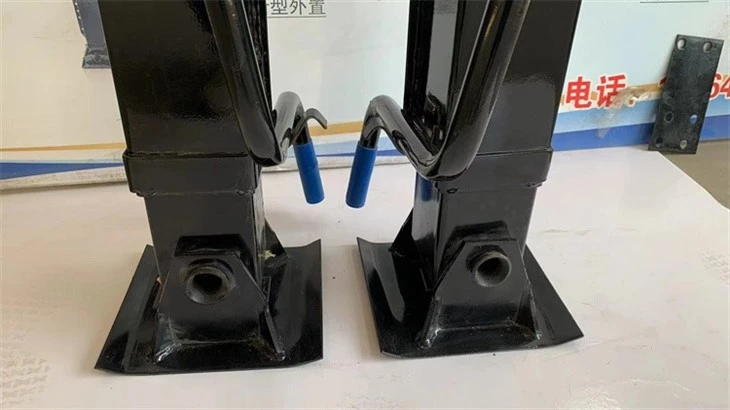
The shape and structure of the support legs also play a vital role in handling torsional forces. Many built in support legs are designed with a tubular or rectangular cross - section. Tubular designs are especially effective as they distribute the torsional stress evenly around the circumference of the tube. This uniform distribution of stress helps prevent localized areas of high stress, which could lead to failure. Rectangular cross - sections, on the other hand, provide additional stability in certain directions, allowing the support legs to better resist twisting in multiple planes.
Another important aspect is the connection between the support legs and the trailer frame. A secure and rigid connection is essential for transferring torsional forces from the legs to the frame effectively. Most support legs are bolted or welded to the trailer frame. Welded connections are generally stronger and more rigid, providing a better path for the transfer of torsional forces. However, proper welding techniques must be employed to ensure the integrity of the connection. Bolted connections, while easier to install and maintain, require high - strength bolts and proper tightening torques to prevent loosening under torsional stress.
In addition to the design and construction features, the internal mechanisms of the support legs also contribute to their ability to handle torsional forces. Many support legs are equipped with a screw - jack or hydraulic system for adjustment. These mechanisms need to be designed to operate smoothly even under torsional loads. For example, the screw - jack system should have a sufficient thread pitch and diameter to resist the twisting forces generated during operation. Hydraulic systems, on the other hand, need to have well - sealed cylinders and high - pressure hoses to prevent leakage and ensure proper functioning under torsional stress.
To further enhance the performance of built in support legs in handling torsional forces, some manufacturers incorporate additional features such as gussets or braces. Gussets are triangular pieces of metal that are welded to the support legs at critical points. They provide additional reinforcement and help distribute the torsional stress over a larger area. Braces, on the other hand, can be used to connect multiple support legs together, creating a more rigid and stable structure. This interconnected system can better resist torsional forces by sharing the load between the legs.
As a supplier of Built in Support Legs, we understand the importance of providing high - quality products that can effectively handle torsional forces. Our support legs are manufactured using the latest technology and the highest quality materials. We conduct rigorous testing on our products to ensure they meet or exceed industry standards for torsional strength.
When it comes to trailer accessories, other components also work in conjunction with built in support legs to ensure the overall stability of the trailer. For example, Axle Brake Pads play a crucial role in controlling the movement of the trailer. Properly functioning brake pads can help reduce the impact of sudden stops or starts, which can generate torsional forces on the support legs. Similarly, Axle Adjusting Arm is used to adjust the position of the axle, which can affect the distribution of weight and the resulting torsional forces on the support legs.

In conclusion, built in support legs are a critical component of trailers, and their ability to handle torsional forces is essential for the safety and stability of the entire system. By understanding the design, construction, and internal mechanisms of these support legs, we can ensure that they perform optimally under various conditions. As a supplier, we are committed to providing our customers with the best - in - class built in support legs that can effectively handle torsional forces.
If you are in the market for high - quality built in support legs or other trailer accessories, we invite you to contact us for more information. Our team of experts is ready to assist you in selecting the right products for your specific needs. Whether you are a trailer manufacturer, a fleet operator, or an individual trailer owner, we can provide you with the solutions you need to ensure the safety and reliability of your trailers.
References
- "Trailer Design and Engineering Handbook"
- "Materials Science and Engineering: An Introduction" by William D. Callister, Jr. and David G. Rethwisch
- Industry standards and guidelines for trailer accessories