

Axle
An axle is a rod or shaft that rotates the wheels and supports the weight of your vehicle. Axles are essential components of any vehicle and come in three main types: front, rear, and stub. A key component of your vehicle, the axles are central shafts that connect to the wheels. They typically turn with the wheels. Since axles control the power that propels the wheels, every vehicle has to have axles in order to operate. A car axle is a central shaft or rod that connects and supports the wheels of a vehicle. Its primary purpose is to transfer power from the engine to the wheels, allowing the vehicle to move forward or backward. Axles are crucial for the vehicle's stability, balance, and overall performance. Without them, your car would be nothing more than an immobile piece of metal.
Advantages of Axle
Increased weight capacity
One of the primary reasons for axle is to increase the weight capacity of your trailer. As your hauling needs evolve, you may find that your current axle setup is no longer sufficient to carry the load. Upgrading to higher-capacity axles allows you to transport heavier cargo safely and within legal weight limits. It is especially beneficial for businesses involved in freight and logistics.
Enhanced durability
Axles are often built with more robust materials and superior manufacturing techniques, increasing their durability and lifespan. It means your trailer can withstand the rigours of long journeys, rough terrains, and heavy loads without succumbing to wear and tear. Improved durability translates to cost savings in the long run, as you’ ll spend less on maintenance and replacements.
Improved safety
Safety should always be a top priority when towing a trailer, whether for work or leisure. Upgrading to high-quality axles and hubs enhances your trailer’ s overall stability and performance. You’ ll experience better handling, reduced swaying, and improved braking, all of which contribute to safer towing experiences.
Better handling
Axles and hubs can significantly improve the handling of your trailer. They provide greater control, stability, and responsiveness when maneuvering on highways or navigating challenging terrains. This improved handling enhances safety and reduces driver fatigue, making long trips more comfortable.
-
 Disc-Brake AxleDisc axle is an axle design with disc brakes, mainly used to improve the braking performance and heat dissipation efficiency of the vehicle.Add to Inquiry
 -
 Drum Brake BridgeThe semi-trailer drum brake axle is a widely used rear axle for semi-trailers in the market. Its main feature is its 360° sealed brake drum design. This design increases the braking friction area,Add to Inquiry
 -
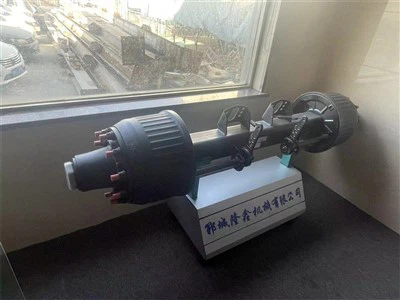 High Quality German AxleGerman type axles are the epitome of precision engineering. They are designed and manufactured to exacting standards, with every component meticulously crafted to ensure optimal performance andAdd to Inquiry
 -
 Hydraulic Steering AxleThe hydraulic steering axle can provide better steering capability for semi-trailers, especially in narrow spaces or complex road conditions, making it easier to complete steering operations.Add to Inquiry
 -
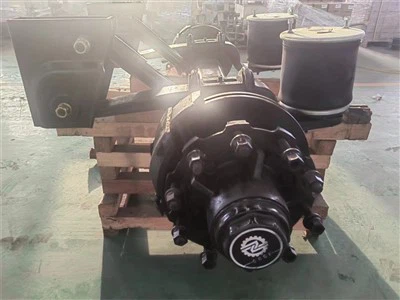 Disc Brake AxlFirstly, the disc axle has a weight advantage over the drum axle because it eliminates the 360° brake drum, greatly improving its own weight. This feature not only helps to increase the cargoAdd to Inquiry
 -
 High Quality Concave AxleAll shaft heads are forged using forging technology. The forging process can ensure the strength and toughness of the axle head, improve the bearing capacity and service life of the overall axle.Add to Inquiry


Why Choose Us
Our factory
Located at the foot of the world-renowned Shuibo Liangshan Mountain, the section of National Highway 220 from Jinan to Zhengzhou is a prime location. Our company is a comprehensive production enterprise that integrates processing, manufacturing, and installation. We have strong mechanical processing capabilities, strong technical strength, and complete testing methods.
Our product
Special vehicle accessories such as disc brake axle, drum brake axle, air suspension, mechanical suspension, semi-trailer support leg, traction pin, air storage cylinder, etc.
Production equipment
Xiang Hengmai CNC sawing machine, hydraulic gate type shearing machine, screw compressor, frozen compressed air dryer, open fixed table press, Xuzhou pressure machinery hydraulic press, four column hydraulic press, suspension double gun automatic welding machine, shot blasting cleaning equipment, centrifugal ventilation fan, 2 sets of Dehong environmental protection spraying equipment, 15 sets of secondary protection welding machines, and 1 set of environmental protection centralized welding smoke purification treatment equipment.
Our service
We adhere to the policy of implementing customer needs and expectations, carrying out customer satisfaction work, implementing the goal of quality first, controlling product production and market, timely communicating with customers in case of after-sales issues, and providing solutions.
How Many Axles Does A Car Have?
2-axle vehicle with 2 axles
The number of axles in a car depends on the type of vehicle. In most cases, cars have two axles to turn the wheels. Larger vehicles that carry more passengers and have more wheels can have more axles. Examples are bicycles, motorcycles, ordinary cars, light trucks, medium-duty trucks, and even some class 8 trucks (package delivery companies that run double trailers, and triples where legal, between terminals tend to use two-axle tractors).
3-axle vehicle with 3 axles
It’ s easy to identify the number of axles your car or other vehicle has. Just look at your car from the side and then count the pairs of tires. Most cars have a total of four tires or two sets of tires, one in the front and one in the rear. Two sets of tires correspond to two axles. Straight trucks with a pair of rear axles to carry the extra weight coming from the cargo, a greyhound bus, some full-size rvs, and majority of tractor units for semi-trailers. 3-axle combination vehicles with small utility trailers also covered. A car like a stretch limousine having three sets of tires also has three axles.
4-axle vehicles with 4 axles
Examples are tri-drive highway tractors that are often used for oversize loads, dump trucks with lift axles, concrete mixers with two steer axles and two drive axles. A 4-axle combination vehicle could also be standard highway tractors with single-axle trailers, 2-axle shunt trucks moving standard 2-axle dry vans around in a trucking company’ s yard or at a distribution center, or a pickup that has a 2-axle travel trailer.
Big freight trucks have 5 axles in total
3 located on the truck and the other 2 on the trailer. An 8-wheeler also has 5 axles, one located in the front, 2 in the middle located at the location where the trailer is attached to the truck and then 2 at the back of the trailer. The axles found underneath the trailer got four wheels per axle. There are vehicles with even more axles but they are specialized vehicles designed to haul the gigantic and long loads.
When a car axle breaks, either abruptly (like hitting a curb) or due to frequent overuse (like driving with too much payload), you’ ll usually know there’ s a problem because the tires simply won’ t spin. However, there are some signs and symptoms of axle damage that might indicate a broken axle—and a visit to an axle repair shop is on the horizon.
The most obvious sign of a broken axle is when your car tires won’ t rotate. The car will turn on fine. Its engine will sound happy as a clam when you rev it. There aren’t any electrical issues—no dashboard warning lights, no weird clicking sounds. Why does this occur? It’ s usually the result of a bent axle joint that’ s finally snapped like a Slim Jim. You’ ll need a tow truck to haul it to a repair shop near you for an inspection and axle damage repair. Car axles are fairly resilient, but when they’ re under pressure, you’ ll feel it in the gas pedal. When an axle is bent or damaged, your vehicle might begin to strain. You’ ll put it into gear and notice right away that power isn’ t getting transferred to the wheels. A straining vehicle doesn’ t necessarily mean that you have a bad car axle, however. This should accompany some other signs of axle damage. Along with straining to move, the vehicle may also make sputtering, bumping or clunking sounds. This is because the axle is not able to transfer adequate power to the wheels.These bad axle sounds will be audible when the car begins to move as well as when turning the wheels.
Underinflated tires, unaligned wheels and loose lug nuts can also make your vehicle vibrate. But if you notice any other signs of axle damage, don’ t disregard it! Your car is incredibly dangerous to drive once you begin noticing vibrations caused by a damaged axle or other suspension problems. You’ ll notice some braking issues once your bent axle starts going bad. The brake pads will begin to shift and become misaligned with the wheels and rotors, and once that happens, you may notice the vehicle skids or slips to a stop. Over time, the brakes will eventually cease to function at all. The brake seal on an AWD or 4WD vehicle’ s driveshaft may shift and begin to leak small amounts of oil. This will be noticeable when looking at the brake drum. Axle CV joints can also leak grease, which is not as detectable. However, once this happens, the joints will collect dirt dry out, and deteriorate quickly.
How Car Axles Work?
Power transfer
In a rwd vehicle, the engine's power is transferred to the transmission, which sends it to the rear differential. The rear differential is a component that splits the power between the two rear wheels. It allows the wheels to rotate at different speeds when turning corners while still receiving power from the engine.
Rotation and movement
As the engine delivers power to the rear differential, the axle shafts rotate, causing the rear wheels to turn. When you press the accelerator pedal, more power is sent to the axle shafts, which in turn rotate the wheels faster, propelling the car forward.

Axle shafts
The rear differential connects to the axle shafts, which are the actual axles of the vehicle. These axle shafts extend from the differential to the rear wheels, transmitting power to them.
Suspension and stability
While the axle shafts transmit power, they also play a vital role in supporting the weight of the vehicle and absorbing road shocks.The suspension system, which includes components like springs and shock absorbers, helps ensure a smooth and stable ride.
Types of Car Axles
Live axles
Live axles, also known as solid axles, are used in rear-wheel-drive (rwd) and some four-wheel-drive (4wd) vehicles. In a live axle setup, the wheels on one side of the vehicle are connected to the axle, and they rotate together as a single unit. Live axles are simple, robust, and cost-effective but can lead to a rougher ride and reduced traction, especially on uneven terrain.
Independent axles
Independent axles also known as irs (independent rear suspension) or ifs (independent front suspension), are commonly found in modern vehicles, including sedans, suvs, and some sports cars. In an independent axle setup, each wheel is connected to its own axle, allowing them to move independently of each other. This design provides better traction, stability, and a smoother ride, especially on rough or uneven roads. It is often preferred for front-wheel-drive (fwd) and all-wheel-drive (awd) vehicles. Car axles come in various types, each designed for specific purposes.
A complete axle assembly on construction equipment performs a number of roles in the drive system of the machine. First the axle assembly must link wheels together and hold them in position as the machine traverses ground. This requires a heavy duty, rugged axle housing to protect the more delicate rotating parts of the axle.
Often, wheels must be allowed to turn independently of one another while still being linked. This variable rotation speed allows the axle to avoid undue stress to the axle itself, as well as, the wheels and the entire machine in conditions where one wheel must turn faster than the other (like when cornering). To perform this task, a differential sits at the center of the axle assembly and allows each wheel to be engaged independently. Since the direction of the force must also be rotated perpendicularly before it can be applied to the wheels, the differential is responsible for this job, as well.
The force output from an engine and distributed to the axle shafts and the wheels often must be converted from a high-speed, low-torque force into a lower-speed, high-torque force. In large construction equipment where low-torque force is required to carry heavy loads or provide steady, firm forward motion, final drives connected to the axle housing and the wheels utilize gear reduction to achieve the required output.
What Are the Parts of an Axle?
Axle housing
An axle assembly will be designed differently depending on the machine it is used on and whether or not the wheels being connected are powered by the drive system. In an axle assembly with powered wheels the basic assembly will consist of an axle housing, axle shafts, differential, and (in machines requiring high-torque output) final drives. The axle housing is a heavy-duty container for all the parts of the axle assembly. It must be designed to protect the rotating inner parts of the axle, connect to the machine, absorb impacts from the ground, and hold the weight of the machine.
Axle shafts
Axle shafts are long rods with spline connections at each ends that run from the differential to the wheel hubs or final drives. These shafts must be designed to withstand constant rotational forces and sudden stopping and starting as they distribute forces to the wheels.
Differential
In a differential, a large ring gear connects with the drive pinion of a shaft and rotates the force 90 degrees so that it can be applied to the axle shafts. If required, the differential also utilizes interconnected gears that allow for the shafts to turn simultaneously or independently, depending on external conditions.
Final drives
In machines where high-torque output is required, final drives are fixed to each ends of the axle assembly. These final drives utilize a number of planetary gear systems and an external ring gear to allow gear reduction to convert the forces being delivered from the axle shafts.
The company was established in 2016 and has undergone 7 years of development. We adhere to the core values of "innovation, quality, integrity, and win-win", constantly breaking through ourselves and pursuing excellence. Located at the foot of the world-renowned Shuibo Liangshan Mountain, the section of National Highway 220 from Jinan to Zhengzhou is a prime location. The Beijing Hangzhou Grand Canal and the South to North Water Diversion Project flow downstream in the east of the city, while the Beijing Kowloon Railway runs directly from north to south in the west. There are three high-speed entrances and exits in the east, west, and north of Liangshan, with a superior geographical location and convenient and fast transportation.


FAQ
We're professional axle manufacturers in China, specialized in providing high quality products with low price. We warmly welcome you to wholesale or buy discount axle from our factory.
axle connectors, axle adapters, axle enclosures