

American Style Suspension
American-style air suspension is typically found in larger rigs and mostly used for custom-built vehicles. This style uses large airbags that are inflated by a compressor and can handle much heavier loads than most other suspension types. The suspension is set up to be adjustable on the fly, making it perfect for off-roading with varying load conditions. This suspension type is best suited for vehicles used for heavy loads such as towing boats, trailers, and heavy equipment. In terms of load-bearing capacity, American-style air suspension is designed to handle more weight than German-style air suspension. The bags in this style are more substantial, and the design is built for durability.
Advantages of American Style Suspension
Competitive cost
Mature technology and reasonable design ensure good quality and competitive cost.
Longer life time
2-3 times durable with longer life time than traditional mechanical suspension.
Improves the suspension comfort and reaction sensitivity
American style air suspension series uses air spring as the spring element, air as the elastic medium, and the air compressibility to achieve elastic operation, which greatly improves the suspension comfort and reaction sensitivity.
More convenient
Deflating the air bag by remote control, height sensor, control valve, etc. To change the height of the vehicle body, making loading and unloading or detaching more convenient.
-
 American Style SuspensionThe American suspension system has a lightweight design, making installation and maintenance relatively convenient. This design also reduces the weight of the suspension system, which helps toAdd to Inquiry
 -
 American Type Equalizer BeamAmerican balance beam is a new trailer accessories produced by our factory, which mainly has the following advantages.. First, American balance beams are known for their strength and durability. ThisAdd to Inquiry
 -
 American Front BracketIntroducing the American-style hanging front rack, the perfect solution for anyone looking to keep their space organized while maintaining a sleek and stylish look. This innovative product isAdd to Inquiry
 -
 American SuspensionThe American suspension system has a lightweight design, making installation and maintenance relatively convenient. This design also reduces the weight of the suspension system, which helps toAdd to Inquiry
 -
 American Light SuspensionAmerican lightweight suspension and high-strength steel are two commonly used technologies or materials in vehicle manufacturing, each with unique advantages. When combined, they can further improveAdd to Inquiry
 -
 American Center BracketAdd to Inquiry
 -
 American Style SuspensionThe American Classic Suspension Series is a premium line of automotive suspension components designed to deliver superior ride quality, durability, and an authentic classic American drivingAdd to Inquiry
 -
 American Suspension Heavy Pull RodThe American style semi-trailer heavy-duty pull rod is a pull rod designed and produced specifically for heavy-duty transport vehicles, which solves the problem of broken pull rods in heavy-dutyAdd to Inquiry
 -
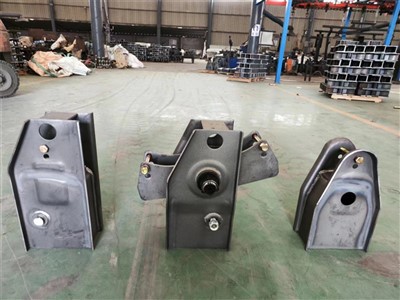 American Reverse Mount SuspensionReverse suspension refers to changing the suspension originally installed above the axle to below the axle, and reinforcing it with riding screws, lower clamps, and invisible arches. ThisAdd to Inquiry


Why Choose Us
Our factory
Located at the foot of the world-renowned Shuibo Liangshan Mountain, the section of National Highway 220 from Jinan to Zhengzhou is a prime location. Our company is a comprehensive production enterprise that integrates processing, manufacturing, and installation. We have strong mechanical processing capabilities, strong technical strength, and complete testing methods.
Our product
Special vehicle accessories such as disc brake axle, drum brake axle, air suspension, mechanical suspension, semi-trailer support leg, traction pin, air storage cylinder, etc.
Production equipment
Xiang Hengmai CNC sawing machine, hydraulic gate type shearing machine, screw compressor, frozen compressed air dryer, open fixed table press, Xuzhou pressure machinery hydraulic press, four column hydraulic press, suspension double gun automatic welding machine, shot blasting cleaning equipment, centrifugal ventilation fan, 2 sets of Dehong environmental protection spraying equipment, 15 sets of secondary protection welding machines, and 1 set of environmental protection centralized welding smoke purification treatment equipment.
Our service
We adhere to the policy of implementing customer needs and expectations, carrying out customer satisfaction work, implementing the goal of quality first, controlling product production and market, timely communicating with customers in case of after-sales issues, and providing solutions.
Weight transfer during cornering, acceleration, or braking is usually calculated per individual wheel, and compared with the static weights for the same wheels. The total amount of weight transfer is only affected by four factors: the distance between wheel centers (wheelbase in the case of braking, or track width in the case of cornering), the height of the center of gravity, the mass of the vehicle, and the amount of acceleration experienced. The speed at which weight transfer occurs, as well as through which components it transfers, is complex, and is determined by many factors; including, but not limited to: roll center height, spring and damper rates, anti-roll bar stiffness, and the kinematic design of suspension links.
In most conventional applications, when weight is transferred through intentionally compliant elements, such as springs, dampers, and anti-roll bars, the weight transfer is said to be "elastic", while the weight which is transferred through more rigid suspension links, such as A-arms and toe links, is said to be "geometric". Unsprung weight transfer is calculated based on weight of the vehicle's components that are not supported by the springs. This includes tires, wheels, brakes, spindles, half the control arm's weight, and other components. These components are then (for calculation purposes) assumed to be connected to a vehicle with zero sprung weight. They are then put through the same dynamic loads. The weight transfer for cornering in the front would be equal to the total unsprung front weight times the G-force times the front unsprung center of gravity height divided by the front track width. The same is true for the rear.
Sprung weight transfer is the weight transferred by only the weight of the vehicle resting on its springs, and not by total vehicle weight. Calculating this requires knowing the vehicle's sprung weight (total weight less the unsprung weight), the front and rear roll center heights, and the sprung center of gravity height (used to calculate the roll moment arm length). Calculating the front and rear sprung weight transfer will also require knowing the roll couple percentage. The roll axis is the line through the front and rear roll centers that the vehicle rolls around during cornering. The distance from this axis to the sprung center of gravity height is the roll moment arm length. The total sprung weight transfer is equal to the G-force times the sprung weight times the roll moment arm length divided by the effective track width. The front sprung weight transfer is calculated by multiplying the roll couple percentage times the total sprung weight transfer. The rear is the total minus the front transfer. Jacking forces are the sum of the vertical force components experienced by suspension links. The resultant force acts to lift the sprung mass, if the roll center is above ground, or compress it, if underground. Generally, the higher the roll center, the more jacking force is experienced.
Basic Knowledge About American Style Suspension
Travel is the measure of distance from the bottom of the American style suspension stroke (such as when the vehicle is on a jack, and the wheel hangs freely) to the top of the American style suspension stroke (such as when the vehicle's wheel can no longer travel in an upward direction toward the vehicle). Bottoming or lifting a wheel can cause serious control problems, or directly cause damage. "Bottoming" can be caused by the American style suspension, tires, fenders, etc. running out of space to move, or the body or other components of the car hitting the road. Control problems caused by lifting a wheel are less severe, if the wheel lifts when the spring reaches its unloaded shape than they are, if travel is limited by contact of American style suspension members.
Many off-road vehicles, such as desert racers, use straps called "limiting straps" to limit the American style suspensions' downward travel to a point within safe limits for the linkages and shock absorbers. This is necessary, since these trucks are intended to travel over very rough terrain at high speeds, and even become airborne at times. Without something to limit the travel, the American style suspension bushings would take all the force, when American style suspension reaches "full droop", and it can even cause the coil springs to come out of their "buckets", if they are held in by compression forces only. A limiting strap is a simple strap, often from nylon of a predetermined length, that stops downward movement at a pre-set point before theoretical maximum travel is reached. The opposite of this is the "bump-stop", which protects the American style suspension and the vehicle (as well as the occupants) from the violent "bottoming" of the American style suspension, caused when an obstruction (or a hard landing) causes American style suspension to run out of upward travel without fully absorbing the energy of the stroke. Without bump-stops, a vehicle that "bottoms out", will experience a very hard shock when the American style suspension contacts the bottom of the frame or body, which is transferred to the occupants and every connector and weld on the vehicle. Factory vehicles often come with plain rubber "nubs" to absorb the worst of the forces, and insulate the shock. A desert race vehicle, which must routinely absorb far higher impact forces, might be provided with pneumatic or hydro-pneumatic bump-stops. These are essentially miniature shock absorbers (dampers) that are fixed to the vehicle in a location, such, that the American style suspension will contact the end of the piston when it nears the upward travel limit. These absorb the impact far more effectively than a solid rubber bump-stop will, essential, because a rubber bump-stop is considered a "last-ditch" emergency insulator for the occasional accidental bottoming of the American style suspension; it is entirely insufficient to absorb repeated and heavy bottoming, such as a high-speed off-road vehicle encounters.
Comparison Of European Style Semi-Trailer Air Suspension And American Style Suspension
European-style semi-trailer air suspension and American-style air suspension are the two most commonly used air suspensions. What is the difference between these two products? The difference between the air suspension of the two semi-trailers is mainly in the structure of the airbag guide arm (load-bearing beam, suspension arm) and the front bracket.
European-style guide arms generally use cast leaf springs, while American-style guide arms are stamped and welded from steel plates. In addition, the front bracket of the American suspension is smaller than the European suspension.The guide arm (load-bearing beam, suspension arm) of the European airbag suspension is one or more leaf springs, and the guide arm is made of casting. Because the guide arm is a leaf spring, it can play a certain buffering role during driving, and can achieve a certain shock absorption compared with the American suspension.
The American suspension guide arm is made of steel stamping and welding. In theory, the weight of the American suspension guide arm will be lighter. The use of stamping and welding guide arms has a great relationship with the small load capacity of American vehicles. Compared with the European suspension, the guide arm of the air suspension of the American semi-trailer is rigidly connected. Both types of semi-trailer air suspension are used by domestic users. As for the choice, it depends on your own needs.

How American Style Suspension Works
When people think of automobile performance, they normally think of horsepower, torque and zero-to-60 acceleration. But all of the power generated by a piston engine is useless if the driver can't control the car. That's why automobile engineers turned their attention to the suspension system almost as soon as they had mastered the four-stroke internal combustion engine.
The job of a American style suspension is to maximize the friction between the tires and the road surface, to provide steering stability with good handling and to ensure the comfort of the passengers. In this article, we'll explore how American style suspensions work, how they've evolved over the years and where the design of suspensions is headed in the future. When people think of automobile performance, they normally think of horsepower, torque and zero-to-60 acceleration. But all of the power generated by a piston engine is useless if the driver can't control the car. That's why automobile engineers turned their attention to the suspension system almost as soon as they had mastered the four-stroke internal combustion engine.
The job of a American style suspension is to maximize the friction between the tires and the road surface, to provide steering stability with good handling and to ensure the comfort of the passengers. In this article, we'll explore how American style suspensions work, how they've evolved over the years and where the design of suspensions is headed in the future. The study of the forces at work on a moving car is called vehicle dynamics, and you need to understand some of these concepts in order to appreciate why a suspension is necessary in the first place. Most automobile engineers consider the dynamics of a moving car from two perspectives:
The sprung mass is the mass of the vehicle supported on the springs, while the unsprung mass is loosely defined as the mass between the road and the suspension springs. The stiffness of the springs affects how the sprung mass responds while the car is being driven. Loosely sprung cars, such as luxury cars, can swallow bumps and provide a super-smooth ride; however, such a car is prone to dive and squat during braking and acceleration and tends to experience body sway or roll during cornering. Tightly sprung cars, such as sports cars are less forgiving on bumpy roads, but they minimize body motion well, which means they can be driven aggressively, even around corners. So, while springs by themselves seem like simple devices, designing and implementing them on a car to balance passenger comfort with handling is a complex task. And to make matters more complex, springs alone can't provide a perfectly smooth ride. Why? Because springs are great at absorbing energy, but not so good at dissipating it. Other structures, known as dampers, are required to do this.
The company was established in 2016 and has undergone 7 years of development. We adhere to the core values of "innovation, quality, integrity, and win-win", constantly breaking through ourselves and pursuing excellence. Located at the foot of the world-renowned Shuibo Liangshan Mountain, the section of National Highway 220 from Jinan to Zhengzhou is a prime location. The Beijing Hangzhou Grand Canal and the South to North Water Diversion Project flow downstream in the east of the city, while the Beijing Kowloon Railway runs directly from north to south in the west. There are three high-speed entrances and exits in the east, west, and north of Liangshan, with a superior geographical location and convenient and fast transportation.


FAQ
We're professional american style suspension manufacturers in China, specialized in providing high quality products with low price. We warmly welcome you to wholesale or buy discount american style suspension from our factory.
compliance for suspension, fire truck suspension, assembly for suspension