

Trailer Suspension
A suspension system in your trailer is a combination of tires, linkages, springs, and shock absorbers. You might not have been keen on knowing about it, although understanding the basics of your trailer suspension types would not only be harmless but also might help you in the future with its overhauling. The suspension in trailers is crucial for several reasons. It affects load-carrying capacity, dictates the trailer's stability on different terrains, and absorbs impacts, thus protecting the cargo from damage and reducing wear.
Advantages of Trailer Suspension
Shock absorption
At its core, the trailer suspension system is designed to absorb shocks from the road. Imagine travelling over a bumpy road; the suspension system takes on the beating instead of the cargo or the vehicle. This absorption protects the integrity of the trailer’ s structure and the condition of the cargo. Without a properly functioning suspension, a trailer’ s contents could be subjected to excessive jostling and vibration, leading to potential damage.
Load distribution
A vital function of the suspension system is to distribute the cargo’ s weight evenly across the trailer’ s chassis. Uneven load distribution can cause excessive wear on particular tires and axles, leading to premature failure and potentially dangerous situations. An effective suspension system ensures that weight is balanced, reducing strain on the trailer’ s structure and increasing the lifespan of its components.
Versatility
Trailer suspension are not a one-size-fits-all. Several types of trailer suspension are available, each with its unique properties, depending on what the trailer is used for. Specialized suspension exist for things like sport or utility trailers, which typically have a single axle. Meanwhile, cargo trailers often have paired suspension that provide more support and stability. It is essential to match the right type and size of the axle to the trailer you own to ensure the best performance.
Stability and handling
Handling and stability are the most noticeable aspects of a suspension system’ s role, especially during cornering, acceleration, or braking. A good suspension minimizes trailer sway and improves maneuverability, which is crucial for the safety of the tow vehicle and the trailer. This is especially important under heavy load conditions or when driving in adverse weather conditions
-
 Air SuspensionTrailer air suspension is an advanced suspension system that uses air springs as elastic components to regulate the ground clearance of semi-trailers by forming compressed air through an airAdd to Inquiry
 -
 Single Point of SuspensionSemi trailer single point suspension is a special suspension system characterized by reducing the common steel plate spring front and rear brackets to a single bracket connected to the vehicle body.Add to Inquiry
 -
 Light Duty SuspensionThe lightweight American suspension, with its unique design and high-quality materials, has brought revolutionary progress to the semi-trailer manufacturing industry. This suspension system isAdd to Inquiry
 -
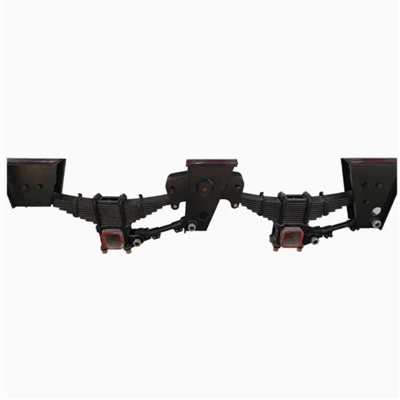 German Style SuspensionAs a manufacturer located in China, we specialize in producing high-quality suspension components for vehicles including trucks, trailers, and buses. Our German Underslung Type Air Suspension is oneAdd to Inquiry
 -
 American Style SuspensionThe American suspension system has a lightweight design, making installation and maintenance relatively convenient. This design also reduces the weight of the suspension system, which helps toAdd to Inquiry
 -
 German Equalizing BeamThe alloy steel steel used in the German balance beam, he is relative to carbon steel, whether in strength, toughness or corrosion resistance is relatively better, and now the common on the market isAdd to Inquiry
 -
 American Type Equalizer BeamAmerican balance beam is a new trailer accessories produced by our factory, which mainly has the following advantages.. First, American balance beams are known for their strength and durability. ThisAdd to Inquiry
 -
 American Front BracketIntroducing the American-style hanging front rack, the perfect solution for anyone looking to keep their space organized while maintaining a sleek and stylish look. This innovative product isAdd to Inquiry
 -
 American SuspensionThe American suspension system has a lightweight design, making installation and maintenance relatively convenient. This design also reduces the weight of the suspension system, which helps toAdd to Inquiry
 -
 American Light SuspensionAmerican lightweight suspension and high-strength steel are two commonly used technologies or materials in vehicle manufacturing, each with unique advantages. When combined, they can further improveAdd to Inquiry
 -
 American Center BracketAdd to Inquiry
 -
 American Style SuspensionThe American Classic Suspension Series is a premium line of automotive suspension components designed to deliver superior ride quality, durability, and an authentic classic American drivingAdd to Inquiry


Why Choose Us
Our factory
Located at the foot of the world-renowned Shuibo Liangshan Mountain, the section of National Highway 220 from Jinan to Zhengzhou is a prime location. Our company is a comprehensive production enterprise that integrates processing, manufacturing, and installation. We have strong mechanical processing capabilities, strong technical strength, and complete testing methods.
Our product
Special vehicle accessories such as disc brake axle, drum brake axle, air suspension, mechanical suspension, semi-trailer support leg, traction pin, air storage cylinder, etc.
Production equipment
Xiang Hengmai CNC sawing machine, hydraulic gate type shearing machine, screw compressor, frozen compressed air dryer, open fixed table press, Xuzhou pressure machinery hydraulic press, four column hydraulic press, suspension double gun automatic welding machine, shot blasting cleaning equipment, centrifugal ventilation fan, 2 sets of Dehong environmental protection spraying equipment, 15 sets of secondary protection welding machines, and 1 set of environmental protection centralized welding smoke purification treatment equipment.
Our service
We adhere to the policy of implementing customer needs and expectations, carrying out customer satisfaction work, implementing the goal of quality first, controlling product production and market, timely communicating with customers in case of after-sales issues, and providing solutions.
Factors to Consider When Choosing a Trailer Suspension
Load capacity
The load capacity of a trailer suspension is one of the most important factors to consider. You need to choose a suspension that can handle the weight of your load, as well as any additional weight you may add in the future. Make sure to choose a suspension with a load capacity that exceeds your needs, to ensure a safe and stable ride.
Ride quality
The ride quality of a trailer suspension is another important factor to consider. You want to choose a suspension that provides a smooth and comfortable ride, even on rough roads. Consider the type of roads you will be driving on and choose a suspension that is well-suited to those conditions.
Adjustability
The adjustability of a trailer suspension is also important. You may want to adjust the suspension to suit different loads or road conditions. Some suspensions are more adjustable than others. Many coil spring systems come with toe and camber adjustments for better tracking and tyre wear. Along with the option to easily swap out coils for different weight ratings. So choose a suspension that offers the level of adjustability you need.
Cost
Finally, cost is an important factor to consider when choosing a trailer suspension. You want to choose a suspension that is within your budget, but also provides the features and performance you need. Make sure to consider the upfront cost, as well as any potential maintenance costs that may arise in the future.
Types of Trailer Suspensions
Leaf spring
Leaf springs are one of the oldest suspension types and are still manufactured in good numbers. These first suspensions are used today for light trailers and are excellent at absorbing blows, yet they are not recommended for heavy-duty use.
Air suspension
Air suspensions are being used in ground vehicles. Making a slight change in the trailing-arm suspension gives us air suspension. The steel springs used in a trailing-arm suspension are replaced by bellows made of textile-reinforced rubber, called airbags/bellows or air springs. The load of the trailer in the air suspensions is borne by these air springs as opposed to the steel springs in the trailing-arm suspensions. Air suspensions are a great choice as they are amazing with all kinds of terrains, although to modify the pressure according to the terrain, you need to have an air compressor or an air cylinder with you.

Trailing-arm suspension
Trailing-arm trailer suspensions were commonly seen in landing gears of aircraft but now are extensively used in ground vehicles as well. A trailing arm or a trailing link has a link or an arm is connected between the axle of the trailer and a pivot point on the chassis. The arm is located at the rear of the axle of the trailer and is also perpendicular to it. Using independent trailing-arm suspensions on the trailer makes every wheel independently move vertically thus making the ride more comfortable.
Rubber suspension
A rubber suspension is a lightweight and relatively simple suspension type. A rubber suspension is a torsion arm suspension. The torsion arm is attached to the frame of the trailer, inside which is a heat-treated inner bar surrounded by 3 or 4 rubber cords. The inner bar rotates when the load is applied, which causes a rolling compressive resistance in the rubber cords. The actions provide the same functions as the conventional sprung axle. A rubber suspension is also independent of the trailing-arm suspension, also rubber cushioning eliminates metal-to-metal contact.
Components of Trailer Suspension Systems
Springs
Springs, whether leaf, coil, or air, are the backbone of any suspension system. They provide the necessary give that cushions the trailer from road irregularities. Each type of spring has its own set of characteristics; for example, leaf springs are renowned for their durability and simplicity, while air springs offer adjustability and a smoother ride quality.
Axles and wheels
Suspension systems directly impact how the wheels and axles wear over time. Properly aligned and functioning suspension components ensure that tires wear evenly and that the axles remain straight and true, reducing maintenance costs and extending the life of the wheels and tires.
Dampers/shock absorbers
While springs absorb the energy from road imperfections, dampers or shock absorbers control the energy’s release. This damping effect prevents the trailer from bouncing uncontrollably after hitting a bump. Effective damping is essential for maintaining contact between the tires and the road, providing a consistent handling experience.
Additional components
Supporting elements like bushings, hangers, and equalizers also play a crucial part in maintaining the overall integrity of the suspension system. These components help dampen vibrations, ensuring that the trailer’s motion is smooth and that the stress on the metal parts is reduced.
Precautions When Using Trailer Suspension
Uneven tire wear
Uneven tire wear is a clear sign that there’ s an issue with the suspension. When the suspension is not working correctly, it can cause the tires to wear unevenly. If you notice that one side of the tire has a different pattern than the other, it’ s time to have your suspension checked.
Excessive bouncing
If your trailer bounces excessively while driving, it’ s a clear indication that the suspension is not functioning correctly. This bouncing can damage your cargo, make your ride uncomfortable, and increase the risk of accidents.
Sagging trailer
If your trailer is sagging on one side, it indicates a broken or worn spring. A sagging trailer can cause imbalance and increase the risk of damage to your cargo.
Difficulty steering
When the suspension system is not functioning correctly, steering your vehicle becomes more challenging. This can be especially dangerous when traveling at high speeds or making sudden turns.
Excessive swaying
Swaying is another sign of faulty suspension. If your trailer sways excessively while driving, it increases the risk of accidents and causes damage to the trailer and cargo.
Strange noises
Unusual noises coming from your trailer could indicate worn or damaged parts in the suspension system. These noises include creaking or banging sounds.
Leaking hydraulic fluid
If your hydraulic suspension system is leaking fluid, it’ s a sign of a damaged hydraulic cylinder or hose. This can cause your suspension system to fail and result in an unsafe ride.
Excessive vibration
If you feel excessive vibration while driving your trailer, it’ s a sign of worn or damaged suspension parts. This can cause damage to your cargo and make your ride uncomfortable.
The ordinary semi-trailer includes the body, axle and suspension system, the axle and suspension system is located at the bottom of the body, wherein the axle is barbell-shaped, with wheels at both ends of the axle, which is arranged horizontally between the body and the axle to connect the axle and body: When the body is dragged by external forces,
The body drives the wheel movement at both ends of the axle through the suspension system. Semi-trailer steel plate spring suspension (referred to as the spring suspension) is divided into less variable cross-section steel suspension and equal cross-section multi-plate spring suspension. At present, more than 95% of the heavy truck suspension system in China is a non-independent suspension with steel plate springs as elastic elements as a guide device, the main advantages of which are simple structure, easy manufacture, easy maintenance, mature process and reliable work. Trailer suspension is a device that connects the trailer frame to the axle wheel. Its main function is to transmit the various forces and torque acting between the wheel and the frame, and to reduce and eliminate the impact load and vibration of the pavement passing through the axle to the frame, in order to improve the smoothness of the trailer driving.

Regular inspections
Examine the suspension system regularly, looking for indications of wear, damage, or lost parts.
Lubrication
Keep pivot points and moving parts well-lubricated to lower friction and increase component longevity.
Tire maintenance
Proper tire inflation and alignment are essential for the best possible suspension performance and tire longevity.
Alignment checks
Periodically check the alignment of the suspension components to ensure proper tracking and handling.
Component replacement
To stop additional damage and guarantee safe operation, replace worn-out or damaged components immediately.
You have rubber torsion suspension. How do I know? Because it’ s on 99.9 percent of all horse trailers. To be sure, look between the tires. If you don’ t see anything (springs and shackles), you have rubber torsion suspension. It is an independent suspension. Each wheel supports the trailer independently of the others. You can drive a short distance with a flat tire. The trailer will remain stable and level, but the adjacent tire will be overloaded drive cautiously. Rubber torsion absorbs the shock of the road.
Rubber torsion axles are free of springs and shackles so they require less maintenance other than regular maintenance of bearings and brakes. If the axle gets bent from hitting something, you need to replace it. Uneven tire wear can be a sign of a bent axle. The other reasons for uneven tire wear are improper inflation and/or a defective tire. If a tire is flat, you won’ t see it. The adjacent tire/axle is holding the trailer level. Always check the tire pressure on all tires. The axles can be blocked up. This will raise the trailer four inches. Goosenecks before 2000 might not clear today’ s taller truck beds and still be level. Blocking the axles will help. Axles have a weight rating stating the weight limit they can sustain. Two 3500 axles will hold 7000 lbs. Safely. Two 5200 lb. Axles will sustain 10400 lbs.
Goosenecks are supported by a third axle your truck axle. It supports 20% to 25% of the weight of the trailer. Factor this in when adding up weight on the axles. Rubber torsion axles work well with drive-on jacks such as traileraide. A trailer has to be level. The weight of the trailer has to be evenly spread across both axles and all four tires. Rubber torsion responds quickly to raising and lowering the trailer.
The company was established in 2016 and has undergone 7 years of development. We adhere to the core values of "innovation, quality, integrity, and win-win", constantly breaking through ourselves and pursuing excellence. Located at the foot of the world-renowned Shuibo Liangshan Mountain, the section of National Highway 220 from Jinan to Zhengzhou is a prime location. The Beijing Hangzhou Grand Canal and the South to North Water Diversion Project flow downstream in the east of the city, while the Beijing Kowloon Railway runs directly from north to south in the west. There are three high-speed entrances and exits in the east, west, and north of Liangshan, with a superior geographical location and convenient and fast transportation.


FAQ
We're professional trailer suspension manufacturers in China, specialized in providing high quality products with low price. We warmly welcome you to wholesale or buy discount trailer suspension from our factory.
