

The axle ratio is a crucial factor that significantly influences a vehicle's performance, fuel efficiency, and towing capabilities. As an axle supplier, we understand the importance of choosing the right axle ratio for different types of vehicles. In this blog post, we will explore what the ideal axle ratio is for various vehicle categories and how it can impact your driving experience.
Understanding Axle Ratio
Before delving into the ideal axle ratios for different vehicles, let's first understand what an axle ratio is. The axle ratio is the number of times the driveshaft must rotate to turn the wheels once. It is expressed as a ratio, such as 3.08:1 or 4.10:1. A lower axle ratio, like 3.08:1, means the driveshaft rotates fewer times to turn the wheels once, resulting in lower engine RPM at a given speed. Conversely, a higher axle ratio, such as 4.10:1, requires the driveshaft to rotate more times, leading to higher engine RPM at the same speed.
Passenger Cars
For passenger cars, the ideal axle ratio depends on the vehicle's intended use and performance characteristics. Most modern passenger cars are designed for a balance between fuel efficiency and performance. A lower axle ratio, typically in the range of 2.73:1 to 3.42:1, is often preferred for cars that prioritize fuel economy. These ratios allow the engine to operate at lower RPMs while cruising, reducing fuel consumption.
On the other hand, high - performance cars may have a higher axle ratio, such as 3.73:1 or even higher. A higher axle ratio provides quicker acceleration because the engine can deliver more torque to the wheels. This is beneficial for sports cars and luxury sedans that are designed for speed and rapid acceleration.
As an axle supplier, we offer a range of axles suitable for passenger cars. Our [High Quality German Axle](/axle/high - quality - german - axle.html) is known for its precision engineering and durability, making it an excellent choice for both fuel - efficient and high - performance passenger cars.
SUVs and Crossovers
SUVs and crossovers come in various sizes and are used for different purposes, from daily commuting to towing and off - road adventures. For smaller, more fuel - efficient SUVs and crossovers, a lower axle ratio similar to that of passenger cars, around 2.73:1 to 3.42:1, is often used. This helps to achieve better fuel economy during normal driving conditions.
However, larger SUVs that are designed for towing or off - road use usually require a higher axle ratio. A ratio in the range of 3.73:1 to 4.10:1 or even higher can provide the necessary torque to pull heavy trailers or navigate through rough terrain. The extra torque helps the vehicle to start moving from a standstill and maintain speed while towing or climbing hills.
Our [High Quality Concave Axle](/axle/high - quality - concave - axle.html) is a great option for SUVs and crossovers. Its unique design provides enhanced strength and stability, making it suitable for both on - road and off - road applications.
Trucks
Trucks are used for a wide variety of tasks, including hauling heavy loads, towing trailers, and long - distance transportation. The ideal axle ratio for trucks depends on their specific use.
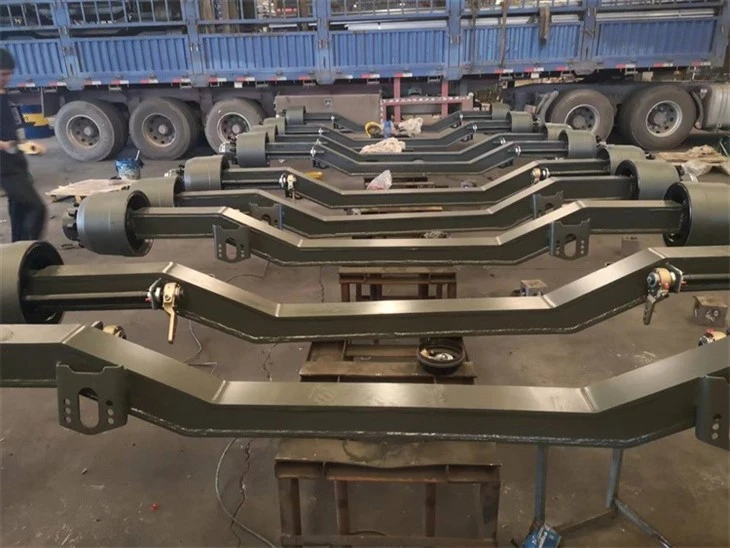

For light - duty trucks used primarily for daily driving and occasional light hauling, a lower axle ratio, such as 3.08:1 or 3.21:1, can offer good fuel efficiency. These ratios allow the engine to operate at relatively low RPMs on the highway, reducing fuel consumption.
Medium - duty and heavy - duty trucks, which are designed for heavy hauling and towing, typically require a higher axle ratio. Ratios of 3.73:1, 4.10:1, or even 4.56:1 are common in these trucks. A higher axle ratio provides the torque needed to move large loads, especially when starting from a stop or climbing steep grades.
Our [Disc - Brake Axle](/axle/disc - brake - axle.html) is specifically designed for trucks. It offers superior braking performance, which is essential for trucks carrying heavy loads. The disc brakes provide better stopping power and are more resistant to fade compared to traditional drum brakes.
Impact of Axle Ratio on Fuel Efficiency
The axle ratio has a direct impact on a vehicle's fuel efficiency. As mentioned earlier, a lower axle ratio allows the engine to operate at lower RPMs while cruising, which generally leads to better fuel economy. However, it's important to note that the ideal axle ratio for fuel efficiency also depends on other factors, such as the vehicle's weight, aerodynamics, and the type of driving (city or highway).
In city driving, where there is a lot of stop - and - go traffic, a slightly higher axle ratio may be more beneficial. The extra torque provided by a higher axle ratio can help the vehicle accelerate more quickly from a stop, reducing the need for excessive revving of the engine. On the highway, a lower axle ratio is usually more fuel - efficient because the engine can maintain a steady speed at lower RPMs.
Impact of Axle Ratio on Towing and Hauling
When it comes to towing and hauling, the axle ratio plays a crucial role. A higher axle ratio provides more torque to the wheels, which is essential for moving heavy loads. When towing a trailer or carrying a heavy payload, a vehicle with a higher axle ratio will be able to start moving more easily and maintain speed on inclines.
However, a higher axle ratio also means that the engine will have to work harder and operate at higher RPMs, which can lead to increased fuel consumption. Therefore, it's important to find the right balance between towing capacity and fuel efficiency when choosing an axle ratio for a vehicle used for towing or hauling.
Choosing the Right Axle Ratio
Choosing the right axle ratio for your vehicle depends on several factors, including your driving habits, the type of terrain you will be driving on, and the vehicle's intended use. If you primarily drive on the highway and want to maximize fuel efficiency, a lower axle ratio is a good choice. If you need to tow heavy loads or drive off - road, a higher axle ratio will provide the necessary torque.
As an axle supplier, we have a team of experts who can help you choose the ideal axle ratio for your specific vehicle and needs. We offer a wide range of axles with different ratios to ensure that you get the best performance and efficiency from your vehicle.
Contact Us for Axle Procurement
If you are in the market for a new axle or need advice on choosing the right axle ratio for your vehicle, we invite you to contact us for a procurement discussion. Our experienced team can provide you with detailed information about our products and help you make an informed decision.
References
- Smith, J. (2018). Automotive Drivetrain Systems. Publisher X.
- Johnson, A. (2019). The Science of Vehicle Performance. Publisher Y.


