

Bogie suspension systems are crucial components in various types of vehicles, especially in trailers and heavy - duty trucks. As a bogie suspension supplier, I have in - depth knowledge of the main components that make up these essential systems. In this blog, I will delve into the key elements of bogie suspension and explain their functions and importance.
Axles
Axles are the fundamental building blocks of a bogie suspension system. They serve as the central shafts around which the wheels rotate. Axles are designed to support the weight of the vehicle and its load, transferring the forces from the wheels to the rest of the suspension. There are different types of axles used in bogie suspensions, such as live axles and dead axles.
Live axles, also known as drive axles, are responsible for transmitting power from the vehicle's engine to the wheels. They are commonly found in trucks where the power is needed to propel the vehicle forward. Dead axles, on the other hand, do not transmit power but only support the weight. They are often used in trailers to distribute the load evenly.
The material and design of axles are critical for their performance. High - strength steel is commonly used to ensure that the axles can withstand the heavy loads and stresses they are subjected to. Axles also need to be properly aligned to prevent uneven tire wear and ensure smooth operation of the vehicle.
Springs
Springs are another vital component of bogie suspension. Their main function is to absorb shocks and vibrations from the road surface, providing a smoother ride for the vehicle and protecting the load from damage. There are several types of springs used in bogie suspensions, including leaf springs, coil springs, and air springs.
Leaf springs are one of the oldest and most commonly used types of springs in bogie suspensions. They consist of multiple layers of curved metal strips, or leaves, stacked on top of each other. Leaf springs are known for their simplicity, durability, and ability to carry heavy loads. They are widely used in commercial vehicles and trailers.
Coil springs are made of a coiled wire and are often used in more modern bogie suspension systems. They offer a more compact design and can provide a more precise spring rate compared to leaf springs. Coil springs are commonly found in light - to medium - duty vehicles.
Air springs, also known as airbags, are a relatively new addition to bogie suspension technology. They use compressed air to support the vehicle's weight and absorb shocks. Air springs offer several advantages, such as adjustable ride height, improved ride quality, and better load - leveling capabilities. They are increasingly being used in high - end trailers and trucks.
Shock Absorbers
Shock absorbers, also called dampers, work in conjunction with the springs to control the movement of the suspension. Their main function is to dampen the oscillations of the springs, preventing the vehicle from bouncing excessively after hitting a bump or pothole.
Shock absorbers use a piston inside a cylinder filled with hydraulic fluid. When the suspension compresses or extends, the piston moves through the fluid, creating resistance. This resistance converts the kinetic energy of the bouncing motion into heat energy, which is dissipated into the surrounding environment.
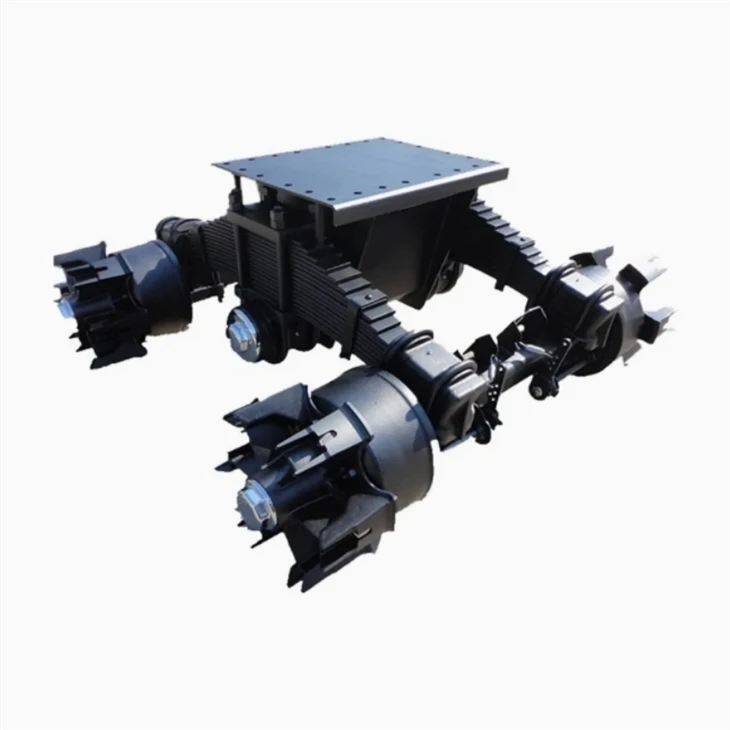

There are different types of shock absorbers, including twin - tube shock absorbers and monotube shock absorbers. Twin - tube shock absorbers are more common and are generally less expensive. Monotube shock absorbers, on the other hand, offer better performance and are often used in high - performance vehicles and heavy - duty applications.
Suspension Arms
Suspension arms, also known as control arms, connect the axle to the vehicle's frame. They play a crucial role in controlling the movement of the wheels and maintaining proper wheel alignment. Suspension arms allow the wheels to move up and down while keeping them in the correct position relative to the vehicle's body.
There are usually two types of suspension arms in a bogie suspension system: upper control arms and lower control arms. The upper control arms are located above the axle, while the lower control arms are below it. These arms are typically made of high - strength steel or aluminum to ensure their durability and strength.
The design and geometry of the suspension arms are carefully engineered to optimize the handling and stability of the vehicle. They also help to reduce the stress on other suspension components, such as the axles and springs.
Bushings
Bushings are small rubber or polyurethane components that are used to isolate the suspension components from each other and from the vehicle's frame. They act as cushions, reducing the noise, vibration, and harshness (NVH) transmitted through the suspension system.
Bushings are installed at the connection points of the suspension arms, axles, and other components. They allow for some degree of movement while providing a certain amount of stiffness to maintain the proper alignment of the suspension. Over time, bushings can wear out due to the constant movement and stress, and they need to be replaced to ensure the continued performance of the suspension system.
Single Point of Suspension
A significant innovation in bogie suspension technology is the Single Point of Suspension. This type of suspension system uses a single pivot point to connect the axle to the vehicle's frame. The single point of suspension offers several advantages, such as improved ride quality, better load distribution, and increased maneuverability.
In a single - point suspension system, the axle is allowed to pivot around the single point, which helps to adapt to uneven road surfaces more effectively. This results in a smoother ride for the vehicle and reduces the stress on the load. Additionally, the single - point suspension design can simplify the installation and maintenance of the suspension system.
As a bogie suspension supplier, we understand the importance of these components working together seamlessly to provide a reliable and high - performance suspension system. Our products are designed and manufactured using the latest technology and highest quality materials to ensure the best possible performance for your vehicles.
If you are in the market for bogie suspension systems or need to replace any of the components mentioned above, we invite you to contact us for a detailed discussion. Our team of experts is ready to assist you in finding the most suitable solution for your specific needs. Whether you are a trailer manufacturer, a trucking company, or an individual vehicle owner, we can provide you with the right bogie suspension products and services.
References
- "Vehicle Suspension Systems" by David Crolla
- "Fundamentals of Vehicle Dynamics" by Thomas D. Gillespie
- Industry whitepapers on bogie suspension technology from leading manufacturers


