

Hey there! As a semi trailer supplier, I often get asked about the ins and outs of refrigerated semi trailers, especially their cooling systems. So, I thought I'd take the time to break it down for you and explain what makes these cooling systems tick.
First things first, let's talk about why a cooling system is so important in a refrigerated semi trailer. These trailers are used to transport perishable goods like food, pharmaceuticals, and other temperature - sensitive products. If the temperature inside the trailer isn't properly regulated, the goods can spoil, which is a huge loss for both the supplier and the customer. That's where the cooling system comes in. It keeps the interior of the trailer at a consistent, low temperature to ensure the safety and quality of the cargo.
There are a few different types of cooling systems commonly used in refrigerated semi trailers. The most popular one is the vapor - compression refrigeration system. This system works on a pretty simple principle, but it's super effective.
The vapor - compression system has four main components: the compressor, the condenser, the expansion valve, and the evaporator. Let's start with the compressor. The compressor is like the heart of the system. It takes in low - pressure, low - temperature refrigerant vapor from the evaporator and compresses it into a high - pressure, high - temperature vapor. This compression increases the energy of the refrigerant, making it ready for the next step.
Next up is the condenser. Once the refrigerant leaves the compressor, it enters the condenser. The condenser is basically a big heat exchanger. It releases the heat that the refrigerant has absorbed from the inside of the trailer to the outside air. As the refrigerant releases heat, it cools down and condenses into a high - pressure liquid.
After the condenser, the refrigerant flows through the expansion valve. The expansion valve is a small, but crucial, component. It reduces the pressure of the high - pressure liquid refrigerant, causing it to expand and turn into a low - pressure, low - temperature mixture of liquid and vapor.

Finally, we have the evaporator. The evaporator is located inside the trailer. As the low - pressure refrigerant enters the evaporator, it absorbs heat from the air inside the trailer. This cools down the air, and the now - warm refrigerant vapor goes back to the compressor to start the cycle all over again.
Another type of cooling system you might come across is the absorption refrigeration system. This system uses a heat source, like natural gas or propane, instead of a compressor. It's not as common as the vapor - compression system, but it has its advantages. For example, it can be more energy - efficient in certain situations, and it produces less noise.
In an absorption refrigeration system, there are three main substances: the refrigerant (usually ammonia), the absorbent (usually water), and the heat source. The heat source heats the mixture of refrigerant and absorbent in the generator. This causes the refrigerant to vaporize and separate from the absorbent. The refrigerant vapor then moves to the condenser, where it releases heat and condenses into a liquid, just like in the vapor - compression system. After that, it goes through an expansion valve and into the evaporator to absorb heat from the trailer. The now - warm refrigerant vapor is then absorbed back into the absorbent, and the cycle repeats.
Now, maintaining the cooling system in a refrigerated semi trailer is super important. Regular maintenance can help prevent breakdowns, extend the life of the system, and ensure that the trailer is operating at peak efficiency. Some basic maintenance tasks include checking the refrigerant levels, inspecting the belts and hoses for wear and tear, and cleaning the condenser coils.
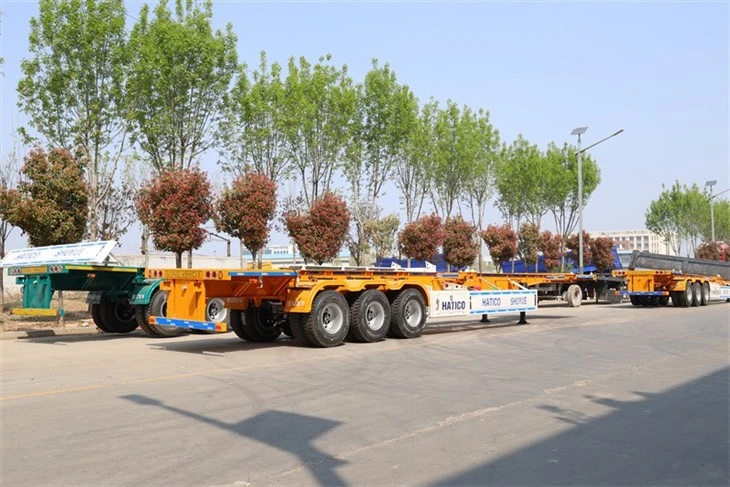
If you're in the market for a refrigerated semi trailer, you might want to check out our Skeleton Transport Semi - trailer. It's a great option that offers reliable performance and a high - quality cooling system.
When choosing a refrigerated semi trailer, there are a few things to keep in mind. First, consider the size of the trailer. You'll need to make sure it's big enough to carry your cargo, but not so big that it's inefficient. Also, think about the cooling capacity of the system. The cooling capacity should be able to handle the amount of heat that the cargo generates and the outside temperature conditions.
Another factor to consider is the insulation of the trailer. Good insulation helps to keep the cold air inside the trailer and the warm air outside. This reduces the workload on the cooling system and can save you money on energy costs.
So, if you're interested in learning more about our refrigerated semi trailers or have any questions about the cooling systems, don't hesitate to reach out. We're here to help you find the perfect trailer for your needs. Whether you're a small - scale food distributor or a large pharmaceutical company, we've got the solutions for you. Let's start a conversation and see how we can work together to get your perishable goods transported safely and efficiently.
References
- ASHRAE Handbook of Refrigeration. This handbook provides in - depth information on all aspects of refrigeration systems, including those used in semi trailers.
- Various industry publications on transportation and refrigeration technology. These publications often feature the latest research and developments in the field.


