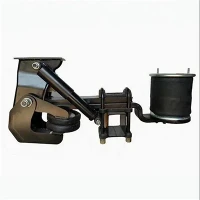

Fixed traction seat The fixed traction seat is currently the most widely used one. Its support is fixed on the frame of the towing vehicle, and the traction seat is allowed to have a certain degree of freedom on the support. Then, according to the different degrees of freedom allowed, there are single degree of freedom, two degrees of freedom and three degrees of freedom. According to their separation-connection mechanisms, they are divided into splint type and hook-pin type. After the tractor is connected to the semi-trailer, first turn the safety baffle to one side, and then pull the handle to move the locking block forward to the L-shaped gap away from the splint, the spring is compressed, and the front end of the splint is pulled by the fixed spring. And close together, and against the locking block.
What is the maintenance of the trailer accessories tow mount?
1. During the first-level maintenance, check the parts of the traction seat, focusing on the wear of the traction pin, traction pin plate, semi-horizontal shaft and other parts, and lubricate each part.
2. Check the lock hole, and use the traction pin for matching detection. If the wear exceeds the limit and the matching gap is large, it can be repaired by surfacing and processing to the required size, or the lock hook, lock block and wear-resistant ring can be replaced for repair.
3. Pay attention to check whether the traction seat itself has cracks and serious wear. If there are cracks or serious wear and the traction seat is deformed or too thin, new parts should be replaced.
4. Check and tighten the bolts of the support seat, and replace the bolts if necessary;
5. Adjust the matching clearance between the lock hook and the traction pin. The adjustment method is to adjust by adjusting the screw, and then lock it with the nut after adjustment. If the fit is loose, replace the rubber elastic bushing. Then drive the tractor forward, that is, complete the disengagement of the semitrailer, and the supporting device of the semitrailer should be lowered before disengagement.